Splunk certifications: where to start

Splunk has more than ten certifications, and the list can be intimidating the first time you look at it. In practice, they are organized into a few tracks, and almost everyone starts in the same place. This guide shows the map, what each exam covers, and how to choose the right sequence for your job.
The data below comes from Splunk's official exam guide. The list changes from time to time; check the certifications page before you register.
The tracks
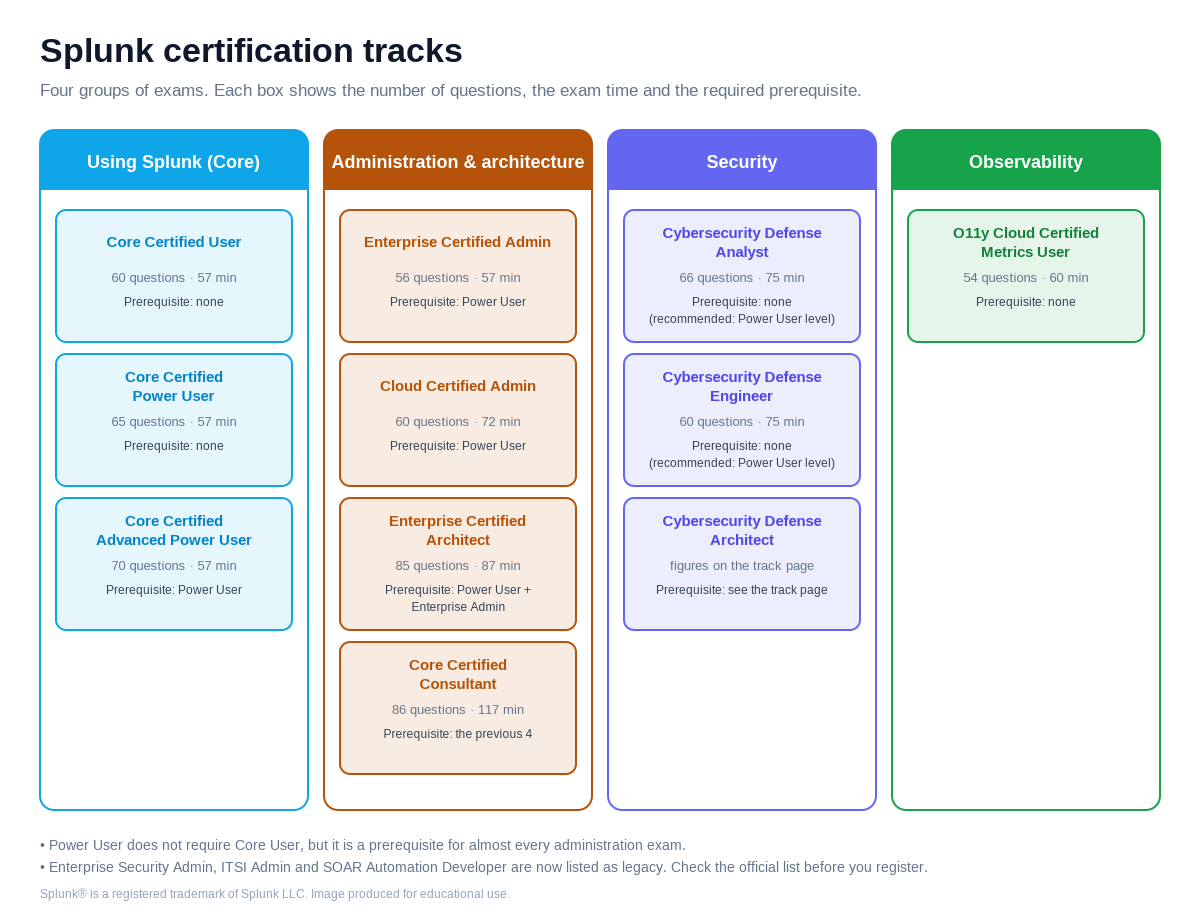
The current certifications fall into four groups:
Using Splunk (Core): for people who run searches and build reports and dashboards.
Administration and architecture: for people who install, configure, and maintain the environment.
Security: for SOC analysts and engineers.
Observability: for people who work with metrics in Splunk Observability Cloud.
User track (Core)
Certification | Questions | Exam time | Prerequisite |
|---|---|---|---|
Splunk Core Certified User | 60 | 57 min | None |
Splunk Core Certified Power User | 65 | 57 min | None |
Splunk Core Certified Advanced Power User | 70 | 57 min | Power User |
Core Certified User is the entry point. It covers everyday basics: searches, using fields, statistics commands such as stats, top, and chart, lookups, reports, alerts, and dashboards. It is the right exam for people who have been using Splunk for a short time or want to prove their foundation before moving on.
Core Certified Power User goes deeper into SPL and into knowledge objects: field extractions, event types, tags, macros, workflow actions, and data models, plus commands such as eval, transaction, and result formatting. It is the most important certification on the list, because it is a prerequisite for almost every administration exam.
Core Certified Advanced Power User is for people who write complex searches: optimization, subsearches, tstats, multivalue fields, eventstats and streamstats, acceleration, and advanced dashboards.
Administration and architecture track
Certification | Questions | Exam time | Prerequisite |
|---|---|---|---|
Splunk Enterprise Certified Admin | 56 | 57 min | Power User |
Splunk Cloud Certified Admin | 60 | 72 min | Power User |
Splunk Enterprise Certified Architect | 85 | 87 min | Power User and Enterprise Admin |
Splunk Core Certified Consultant | 86 | 117 min | Power User, Advanced Power User, Enterprise Admin, and Architect |
Enterprise Certified Admin covers administering Splunk installed on your own infrastructure: licensing, indexes, users and roles, forwarders, data inputs, the deployment server, and the configuration files (inputs.conf, props.conf, indexes.conf, and others).
Cloud Certified Admin is the Splunk Cloud version, where Splunk owns the infrastructure and the administrator takes care of data, apps, users, and forwarders. Choose between the two based on the environment you work in; many people end up taking both.
Enterprise Certified Architect deals with distributed environments: sizing, indexer clusters, search head clusters, multisite, and troubleshooting. It is the most demanding exam in the technical track and requires real experience with large environments.
Core Certified Consultant completes the track and is aimed at people who deploy Splunk for customers. It requires the four previous certifications.
Security track
Certification | Questions | Exam time | Prerequisite |
|---|---|---|---|
Splunk Certified Cybersecurity Defense Analyst | 66 | 75 min | None (Power User level recommended) |
Splunk Certified Cybersecurity Defense Engineer | 60 | 75 min | None (Power User level recommended) |
Splunk Certified Cybersecurity Defense Architect | — | — | Check the track page |
Cybersecurity Defense Analyst is for SOC analysts: investigation, alert triage, frameworks such as MITRE ATT&CK, threat hunting, and using Splunk Enterprise Security and SOAR in the analyst's work.
Cybersecurity Defense Engineer is for people who build detections: creating and tuning detections, risk-based alerting, data normalization with the CIM, and automation.
Cybersecurity Defense Architect is the newest exam in the track and covers the design of the security operation as a whole.
The former Enterprise Security Certified Admin, IT Service Intelligence Certified Admin, and SOAR Certified Automation Developer are now listed as legacy. If you are just starting out in security, choose the Cybersecurity Defense track exams.
Observability
The Splunk O11y Cloud Certified Metrics User (54 questions, 60 minutes, no prerequisite) covers the use of Splunk Observability Cloud: metrics, charts, dashboards, and detectors. It is a different product from Splunk Enterprise, so it only makes sense if you work with it.
Which sequence to follow
Your job | Suggested sequence |
|---|---|
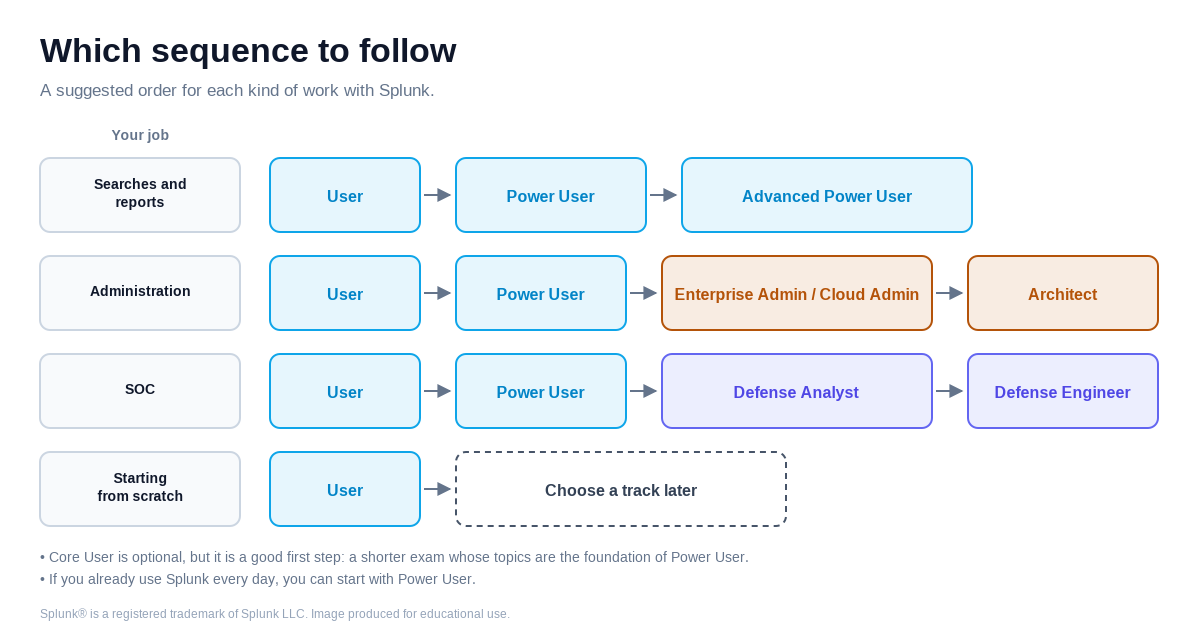
I use Splunk for searches and reports | Core User → Power User → Advanced Power User |
I administer Splunk | Core User → Power User → Enterprise Admin or Cloud Admin → Architect |
I work in a SOC | Core User → Power User → Cybersecurity Defense Analyst → Defense Engineer |
I'm starting from scratch | Core User, then choose a track |
Power User does not require Core User. Even so, for beginners, Core User is a useful step: the exam is shorter, its topics are the foundation of Power User, and passing it shows whether your way of studying is working. If you already use Splunk every day, you can go straight to Power User.
What the exams are like
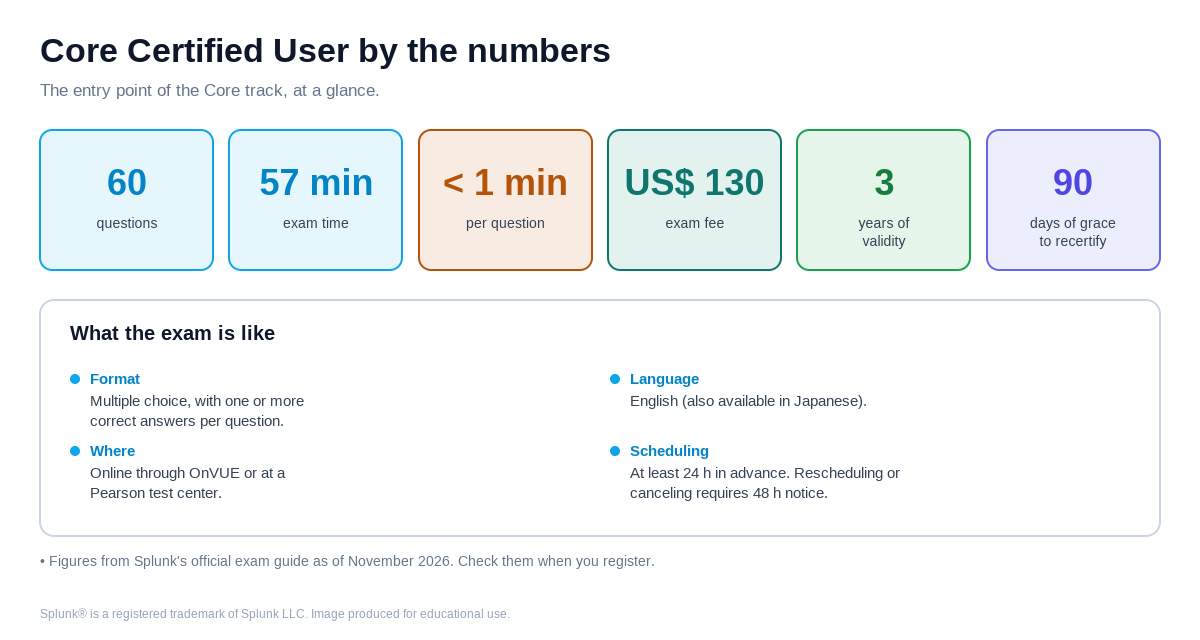
Format: multiple choice, with one or more correct answers per question.
Language: English. Core Certified User is also available in Japanese.
Where: online, with remote proctoring through OnVUE, or at a Pearson test center. You register on Splunk's page at Pearson.
Price: Core Certified User costs US$130. Check the price of the other exams when you register.
Scheduling: at least 24 hours in advance. Rescheduling or canceling requires 48 hours; after that, the fee is forfeited.
Time is tight: in Core User, there are 60 questions in 57 minutes, less than a minute per question. Practicing with questions at the same pace makes a difference on exam day.
Validity and recertification
Certifications are valid for three years. To renew, you can retake the exam, earn another certification in the track, or meet the continuing education requirements. After expiration, there is a 90-day grace period to recertify.
Where to study
Official blueprint: each exam has a document listing the topics covered and the weight of each one. Use it as a checklist.
Splunk courses: there are free online courses for the Core track topics, such as Intro to Splunk, Using Fields, Visualizations, and Leveraging Lookups and Subsearches.
Practice: install Splunk on your computer (the trial version lasts 60 days) and repeat the commands with real data.
Course in Portuguese: the Introdução ao Splunk course on Udemy covers installation, basic SPL, reports, and dashboards.
Practice questions: on We Challenge, you practice with Splunk questions and see the explanation for each answer.
Soon we will publish a week-by-week study plan for Core Certified User here.
Want to practice? Try the free We Challenge sample, with Splunk questions and explanations.
To start from scratch, see the Introduction to Splunk course on Udemy (in Portuguese). For your team, see WeValuate's Splunk training.
Questions about the post? Content suggestions? Corrections? Criticism or praise?
Please contact us at wevaluatebr@gmail.com and we will reply as soon as possible.
If you liked it, share this post on your social networks and help us spread the word!
Comments